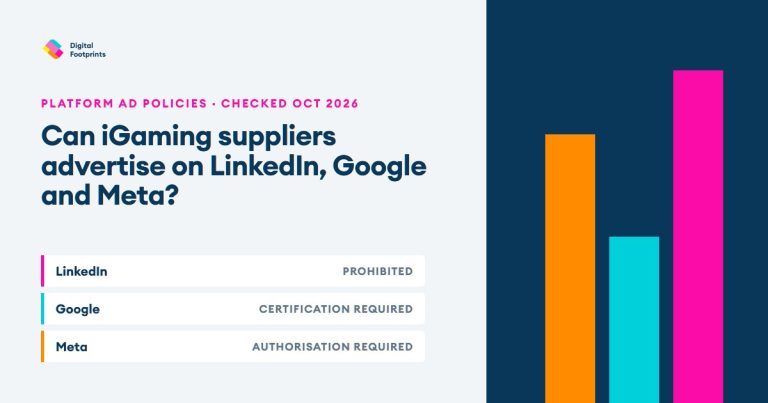
On LinkedIn, no. On Google and Meta, only in a narrow grey area. LinkedIn’s advertising policy says “Ads related to gambling or sweepstakes of any kind are prohibited”, with no carve-out for business-to-business. Google and Meta write their rules around consumer gambling: Google certifies operators and affiliate sites, and Meta authorises advertisers who promote online gambling. Neither policy page mentions suppliers, platform providers or B2B, so a supplier’s ad is judged on what its creative and landing page show.
We read each platform’s official policy on 19 October 2026 and quote them below. Then we cover where the effort should go instead. Our view is that operators find suppliers in the trade press, on Google and in AI answers. A paid search ad can buy a Google placement if it clears review, but no ad budget buys trade coverage, an organic ranking or a mention in an AI answer.
Key takeaways
- LinkedIn bans gambling-related ads outright. Its policy was last revised on 18 November 2025 and has no B2B exception.
- For online gambling, Google certifies operators and affiliate sites only, so a supplier ad must stay clear of “gambling-promoting content”.
- Meta’s rule also catches ads whose landing pages “contain promotions for online gambling or games”. For suppliers, the landing page usually decides it.
- LinkedIn’s ad ban doesn’t cover organic posts, but since 1 September 2025 the UK’s CAP Code can, if you hold a UK licence.
- Semrush’s March 2026 study found LinkedIn in 11% of AI answers on average across three AI search tools.
This is our reading of public platform policies and is not legal advice. For the UK rules themselves (the CAP Code, the ASA and the Gambling Commission), see our LinkedIn Live on iGaming marketing and regulation.
The three platforms side by side
None of the big three gives a supplier a clear yes. This is how we read each policy for a company selling to operators.
| Platform | What the policy says | For a B2B supplier | Better route |
|---|---|---|---|
| “Ads related to gambling or sweepstakes of any kind are prohibited.” | Banned | Company page and executive posts | |
| Google Ads | Certification needed for “gambling and gambling-promoting content”. Only operators and affiliate or comparison sites are eligible. | Grey: no supplier route | Organic rankings for category terms |
| Meta | Authorisation needed to promote online gambling, including via the landing page | Grey: depends on the landing page | Corporate landing pages, organic posts |
Our advice is to plan a launch as if the paid route isn’t there, and count any approved ad as a bonus.
LinkedIn bans gambling ads, with no B2B exception
We read the ban as covering software sold to casinos. The LinkedIn Advertising Policies put gambling under “Prohibited Content” in one line: “Gambling and Sweepstakes. Ads related to gambling or sweepstakes of any kind are prohibited.” “Related to” and “of any kind” are wide enough to catch a sportsbook platform, a casino content aggregator or a payments provider whose ad talks about gambling. The policy page was last revised on 18 November 2025.
Alcohol, financial services and cryptocurrency sit on a separate “Restricted Content” list that can run under conditions. Gambling doesn’t, so there’s no permission to apply for. LinkedIn says it usually reviews ads “within 24 hours”, so at least a rejection arrives quickly.
Does a B2B supplier need Google gambling certification?
Only if the ad counts as gambling-promoting content, and a supplier can’t get certified for that. Google’s Gambling and games policy says “Advertisers need to apply for certification from Google in order to run gambling and gambling-promoting content.” It defines gambling-promoting content as “content which directly promotes engagement in gambling activities” and/or content that “requires authorisation under local law”.
Two kinds of advertiser can be certified. Operators can promote online gambling, and gambling-promoting content is limited to “aggregator or affiliate sites that provide information about, or a comparison of, other gambling services”. Anything else in that category “is not allowed”. The UK section is about operators too: operators of online bingo, sports betting, online casino games and lotteries “must be registered with the Gambling Commission and have a valid operating licence number.” The page doesn’t mention suppliers or B2B.
So a platform ad aimed at operators, which encourages nobody to bet, arguably falls outside the definition. If a reviewer reads it as gambling-promoting, though, there’s no certificate to fall back on. Google hasn’t published B2B guidance, so this is our reading.
Agencies should note two 2026 changes. Google’s March 2026 eligibility update took effect on 23 March 2026. It says applicants “must now demonstrate good policy health”, and manager accounts with a “significant volume” of revoked gambling certificates “will lose the ability to apply for any new online gambling certificates”. The August 2026 global update brought in revised application forms from 26 August 2026 and requires applicants to “hold a valid local licence for every region that you intend to target”.
Can a supplier advertise on Meta?
Possibly, if neither the ad nor its landing page promotes online gambling. Meta’s Online gambling and games policy says “Ads that promote online gambling and gaming are only allowed once an ad account has obtained authorisation”. Advertisers request it in Meta Business Suite with “evidence that the gambling activities are appropriately licensed by a regulator or otherwise established as lawful in the territory they want to target”. Authorised ads still can’t target under-18s or the 19 markets Meta lists as unsupported, among them India, Indonesia and Singapore.
The clause for suppliers is about destinations. Authorisation is required for “Ads with destination (landing) pages that contain promotions for online gambling or games, even if there is no opportunity to gamble or game directly on that page, such as aggregator or affiliate sites.”
Meta’s list of what can run without permission includes land-based casinos, state lotteries and free-to-play games, but not B2B. The policy also moves often: its change log lists ten dated updates between October 2024 and May 2026.
An ad for a compliance tool that lands on a plain corporate page is the strongest case. A page with playable demos, an operator’s welcome offer or a game lobby looks like gambling promotion to a reviewer, whoever the ad targets.
Where to put the effort instead
Put the budget where operators look: trade press, organic search, AI answers and LinkedIn feeds. Platform ad policies don’t apply to any of them. UK rules still can. If you hold a UK licence, check whether your own posts count as marketing under the CAP Code before you treat organic channels as rule-free.
Trade press. B2B iGaming titles are read by people at operators, and coverage there skips ad review. Viktoriia Grygorenko, CEO of The Playa, told Footprints in the Market S4 E3 that her team “got quite some PR coverage for free”, adding: “it depends on whether you have something important and interesting to give.” Trade coverage is the channel our marketing and PR team works in.
Search. Google’s guide to AI features and your website says “The best practices for SEO remain relevant for AI features in Google Search (such as AI Overviews and AI Mode). There are no additional requirements to appear in AI Overviews or AI Mode”. Ranking for your category terms, the work of our iGaming SEO service, puts you in both.
AI answers. Profound tracked citations from November 2025 to February 2026 and found LinkedIn was the most-cited domain for professional queries across six AI platforms. Profound sells AI tracking, so weigh it as a vendor finding.
Is LinkedIn worth it when suppliers can’t buy ads?
Yes, as a publishing channel. LinkedIn’s own rules leave room for it. The ad ban covers ads. For ordinary posts, LinkedIn’s Restricted goods and services page (read 19 October 2026) lists “Gambling sites and services” among the things it removes when a post gives “direct-to-purchase links and/or private contact information to facilitate the sale”. We read that as a rule about selling to players. An executive’s view on a market opening sells nothing, but a post linking straight to a casino or sportsbook would fall foul of it.
UK rules are a different matter. On 1 September 2025, CAP extended the CAP Code to non-paid-for online marketing aimed at UK consumers by advertisers whose licence conditions require CAP Code compliance, “even where the advertiser does not have a UK-registered company address”. CAP named social media posts by licensed gambling operators on their own channels. If your company holds a UK licence, treat its organic posts as marketing that can fall in scope. We’re publishing a separate guide on when the UK rules apply to a supplier.
Semrush’s LinkedIn AI visibility study, published on 10 March 2026, analysed 89,000 LinkedIn URLs cited by ChatGPT Search, Google AI Mode and Perplexity across 325,000 prompts run in January and February 2026. LinkedIn appeared in 11% of AI responses on average, from 14.3% on ChatGPT Search to 5.3% on Perplexity. Four findings help a small supplier team:
- Between 54% and 64% of cited posts “focus on sharing knowledge or practical advice”. Reshares are “rarely referenced”.
- Most cited posts had moderate engagement, around 15 to 25 reactions, so reach isn’t the test.
- About three-quarters of cited authors were frequent posters, which Semrush defines as more than five posts in the previous four weeks.
- Perplexity cites company pages most often (59% of its LinkedIn citations), while ChatGPT Search and Google AI Mode lean towards individual members.
For a supplier, that points to two or three named people who each post at least five times every four weeks, a little more than once a week. Think of the CEO, the commercial lead and a compliance or product head, with the company page running alongside. Write about what a regulatory change means for integrations or what operators asked at the last show, and keep the pitch for the meeting.
For video, MConverts CEO Manik Kochian covered LinkedIn video for B2B iGaming on Footprints in the Market S4 E4.
Frequently asked questions
Can you run gambling ads on Facebook?
For online gambling, only once Meta has authorised your ad account. You need evidence that the activity is licensed by a regulator or lawful in each target territory. Authorised ads can’t target under-18s or the 19 markets Meta lists as unsupported. Land-based casinos, state lotteries and free-to-play games can advertise without that permission.
Can iGaming suppliers post about their products on LinkedIn?
Yes, organically. LinkedIn’s ad policy bans gambling-related ads, and its restricted goods rules remove posts that link directly to gambling sites to facilitate a sale. Industry commentary without those links isn’t covered. If your company holds a UK licence, the CAP Code can treat those posts as marketing.
What does Google require from UK gambling advertisers?
Certification first. In the UK, Google says operators of online bingo, sports betting, casino games and lotteries need Gambling Commission registration and a valid operating licence number. Since 26 August 2026, applicants also need a valid local licence for every region they target. B2B suppliers have no certification route, so organic search usually does more for them.
Are the platforms tightening their gambling ad rules?
Yes. LinkedIn already bans gambling-related ads. Google added a “good policy health” test on 23 March 2026 and revised certification forms on 26 August 2026. Meta’s change log shows ten dated updates between October 2024 and May 2026. In the UK, the CAP Code has covered organic posts by licensed advertisers since 1 September 2025.
Which channels work best for B2B iGaming thought leadership?
Trade press and LinkedIn. Executive posts need time rather than ad spend, LinkedIn’s ad ban doesn’t apply to them, and Semrush found LinkedIn in 11% of AI answers on average across three AI search tools. If your company holds a UK licence, treat those posts as marketing under the CAP Code.
Get on the shortlist without the ad budget
LinkedIn won’t sell a supplier an ad, and Google and Meta leave only a grey area. In our experience, the suppliers operators shortlist are the ones they’ve read about in the trade press, found on Google and seen named in AI answers. We’ve worked in iGaming marketing since 2010. Our line is “The Safest Bet in iGaming”, so we’ll tell you a channel is closed before you spend on it. Talk to our marketing and PR team about the ones that are open, or our paid media team about the platforms that will take a supplier’s ads.
Sharon McFarlane is Managing Director of Digital Footprints, the Glasgow agency that has worked in iGaming marketing since 2010, and host of the Footprints in the Market podcast. Who we are.